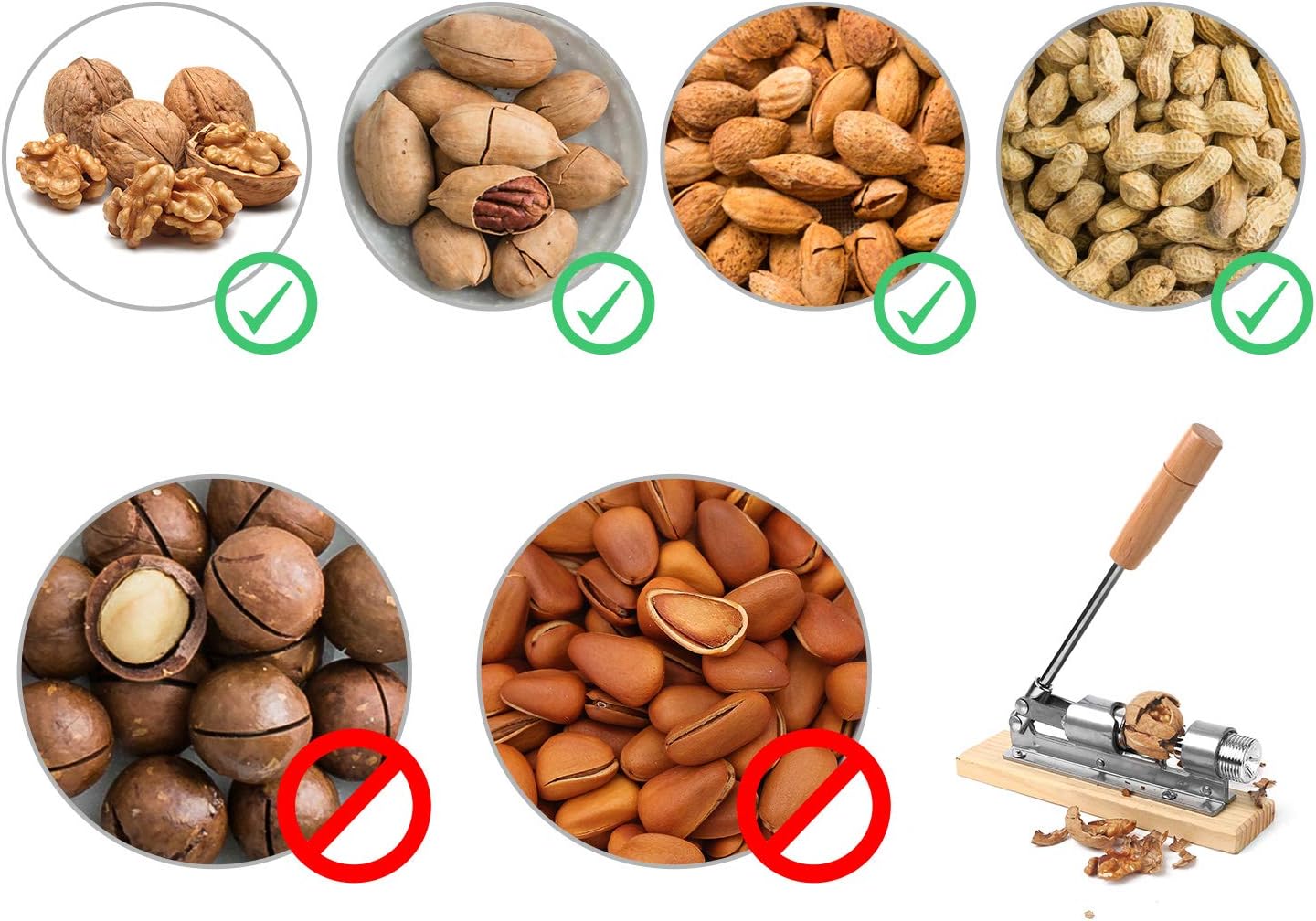
If you’ve ever tried cracking a black walnut — the wild, intensely flavored American nut with a hull like a small cannonball — with a standard nutcracker, you already know the outcome. The tool bends, slips, or shatters the meat into dust before the shell fully gives. Black walnuts (Juglans nigra) are categorically different from the Persian (English) walnuts you find at the grocery store. Their shells are dramatically thicker and more irregular, requiring what nut processors call high-mechanical-advantage tools — devices that multiply the force your hand applies through leverage, gear ratios, or a cam mechanism, rather than a simple squeeze. This guide is for readers who are past the “any nutcracker will do” phase and are making a deliberate purchasing decision: maybe you’re processing a backyard harvest, supplying a specialty food operation, or stocking a cottage food kitchen. We’ll break down which tool categories actually hold up, where each design fails, and how to match your volume and budget to the right choice.
| EDITOR'S PICKGet Crackin' Nut Cracker-Black… | Mid-tier[New Star Foodservice 28003 Heav…](https://www.amazon.com/dp/B00GBG6QBY?tag=greenflower20-20) | Budget pick[Westmark Nutcracker for All Nut…](https://www.amazon.com/dp/B001CJV61U?tag=greenflower20-20) | |
|---|---|---|---|
| Material | — | Nickel-plated Steel/wood | Die-Cast Aluminum |
| Nuts Supported | Black Walnut, English Walnut, Pecan, Hazel Nut, Filbertnut, Macadamia | Pecan | All Nuts: Walnut, Pecan, Hazelnuts, Almonds, Lobster |
| Country of Origin | — | — | German Design |
| Price | $89.95 | $12.99 | $9.99 |
| See on Amazon → | See on Amazon → | See on Amazon → |
Why Black Walnuts Break Average Nutcrackers
The core problem is compressive force. The University of Missouri Extension’s publication Black Walnut: Harvesting and Processing notes that black walnut shells require substantially more cracking force than English walnuts — industry practitioners commonly cite figures in the 30–80 pounds-per-square-inch range depending on shell thickness and moisture content, compared to roughly 10–20 PSI for a typical English walnut. That gap is not marginal. It’s the difference between a tool that functions and one that deforms.
Standard lever-style nutcrackers — the classic chrome-plated pincer you find in holiday gift sets — are typically cast from zinc alloy (sometimes called Zamak), a low-cost die-cast metal that reviewers at The Spruce Eats consistently describe as “decorative rather than functional” for hard-shell varieties. Under repeated black walnut loads, zinc-alloy joints fatigue and pivot pins shear. Even some entry-level steel crackers suffer from thin pivot hardware that acts as the first failure point.
The design variables that matter for durability under black-walnut pressure are:
- Frame material: Forged or cast steel vs. zinc alloy vs. aluminum
- Mechanical advantage ratio: How much the design multiplies your input force
- Contact geometry: Cup-style cradles that stabilize the nut vs. flat jaw pairs that let it slip
- Pivot/joint quality: Pin diameter, thread engagement, and whether the assembly can be retightened or replaced
The Three Tool Categories Worth Comparing
1. Ratchet-Style and Compound-Lever Crackers ($15–$55)
These are the workhorses for home-scale black walnut processing. A compound lever uses two linked pivot points to multiply force — think of it as a lever acting on another lever. A ratchet-style cracker adds a pawl mechanism so you can apply incremental pressure without repositioning.
The Kenyon Industries Master Cracker and similar designs in this class are built from heavy-gauge steel plate with welded or machined pivot hardware. Owners processing 10–30 pounds of in-shell black walnuts per season consistently report these hold up without loosening at the joints over multiple years of use. The tradeoff: they’re slower per nut than a large-capacity press, and kernel extraction rates depend heavily on the operator’s technique — rushing the crack often produces more shell fragments mixed with meat.
Aggregate review patterns across long-run owner accounts suggest the failure mode to watch is the cup or cradle: thinner stamped-steel cups can deform after a few hundred nuts if the nut isn’t centered. Look for crackers where the cup is either cast as part of the frame or welded rather than pressed-in.
Decision frame: If your volume is under 40 lbs. in-shell per year and you’re a home or cottage-food processor, a quality compound-lever cracker in the $30–$55 range covers the load. Spending more doesn’t change the physics meaningfully at this volume.
2. Bench-Mount and Table-Clamp Screw-Press Crackers ($45–$120)
The screw-press style — a threaded shaft that drives a plate down onto a cradled nut — delivers the highest mechanical advantage of any manual design. Because force is applied through thread pitch rather than lever length, operators can achieve controlled, high-pressure cracks without the burst-and-scatter problem common to lever designs.
The Master Nut Cracker (manufactured by Kenyon Industries, sold under the Master Cracker brand) and the Texas Native style bench crackers in this segment are built from cast iron or heavy-gauge welded steel and mount to a table edge via a C-clamp. Wirecutter’s nutcracker coverage notes that bench-mounted designs consistently outperform handheld tools for hard-shell varieties in terms of kernel integrity — less shatter, more whole halves or quarters. For a cottage food operator selling whole or half kernels at a premium, kernel yield is a direct margin variable.
The screw mechanism itself is the longevity variable: look for crackers where the screw is steel-on-steel or steel-on-bronze, not steel threading into a cast-zinc housing. The latter strips under sustained seasonal use. Operators in long-run reviews note that the screw channel is almost always what degrades first, and on quality units it can be cleaned and re-lubricated rather than replaced.
Decision frame: If kernel appearance and yield matter — i.e., you’re selling whole or half kernels — the screw-press format pays for itself quickly. At $65–$90 for a well-made unit, the cost-per-use math favors this category over cheaper lever models within a single serious harvest season.
3. Commercial-Grade Black Walnut Crackers ($400–$2,500+)
For small-batch commercial operators cracking 50+ lbs. per week, the hand-tool conversation ends and the equipment conversation begins. The Savage Industries black walnut cracker and the Meadows Mills cracker (both U.S.-made, bench or floor-mount designs) are the established names in this segment. These use flywheel-assisted or motor-driven impact mechanisms that crack via a brief, high-energy strike rather than sustained compression — a fundamentally different approach that produces higher throughput with lower operator fatigue.
Serious Eats’ overview of black walnut processing notes that impact-style crackers tend to produce more shattered kernel fragments than screw-press designs, but the throughput advantage (some units rated at 25–50 lbs. in-shell per hour) makes fragment rate acceptable for operations selling chopped or ground product rather than whole kernels.
Published manufacturer specs on the Savage cracker put its cast iron frame weight at approximately 35 lbs., a useful proxy for build robustness. Consumer Reports’ broader manual kitchen tool durability guidance suggests frame mass relative to applied force is a reliable longevity indicator — heavier frames absorb vibration that would otherwise fatigue joints and fasteners.
Decision frame: If you’re clearing more than 100 lbs. in-shell per season, the math on a commercial cracker closes within 2–3 seasons when you factor in operator time saved and reduced tool replacement costs. If your output is chopped/ground kernel rather than whole halves, the impact-style design is a strong fit. If whole or half kernels are your value proposition, budget for a screw-press commercial unit or accept a lower throughput rate.
By the Numbers
| Tool Category | Typical Price Range | Best Volume Range | Primary Failure Mode |
|---|---|---|---|
| Compound-lever / ratchet | $15–$55 | Under 40 lbs./season | Cup deformation, pivot wear |
| Bench-mount screw-press | $45–$120 | 40–150 lbs./season | Screw-channel thread strip |
| Commercial impact/flywheel | $400–$2,500+ | 100+ lbs./season | Bearing wear, flywheel alignment |
Material and Build Quality: What the Spec Sheets Tell You
Not all “steel” nutcrackers are equivalent. Here’s what to look for when reading product listings:
Cast iron — Excellent compressive strength, brittle under lateral impact. Fine for screw-press designs where force is vertical; less ideal for impact designs where the frame absorbs shock obliquely. Operators in long-run reviews note cast iron crackers chip at corners if dropped, but the functional working surfaces stay true for decades.
Forged steel — The strongest option, typically found only in commercial equipment or premium bench units. Forgings are grain-aligned to the stress path, meaning the metal is strongest exactly where force travels. Spec sheets that specify “drop-forged” or “hammer-forged” steel are making a meaningful claim.
Cast steel (vs. cast iron) — Higher tensile strength than cast iron, more expensive to produce. Some mid-range bench crackers use cast steel housings with machined contact surfaces. A useful upgrade over cast iron where impact loads are present.
Zinc alloy / Zamak — Avoid for black walnut service. Consumer Reports’ analysis of kitchen tool failures consistently cites zinc-alloy castings as high-risk under sustained or high-load applications. The material is fine for decoration or low-load use but is not a durability choice.
Making the Call: If X, Then Y
The decision tree here is relatively clean once you frame it around volume and output format:
If you’re cracking fewer than 40 lbs. in-shell per year for personal or small-gift use → A quality compound-lever or ratchet cracker in forged or heavy-gauge welded steel ($30–$55) is your ceiling. Don’t pay more. The physics don’t change, and kernel quality at this volume is mostly technique.
If you’re a cottage food operator selling whole or half kernels at farmers markets or through specialty retailers → A bench-mount screw-press cracker in the $65–$110 range is where the economics land cleanly. Kernel yield and appearance matter to your margin, and this format protects both. Budget $20–$30 annually for cleaning and re-lubrication of the screw mechanism.
If you’re running a small-batch commercial operation with 100+ lbs. weekly throughput and selling chopped or ground product → The Savage or Meadows Mills class of commercial crackers at $400–$900 closes the ROI calculation within two to three harvest seasons. Prioritize units with replaceable/serviceable wear parts over welded assemblies you can’t service in the field.
If whole-kernel yield is your commercial value proposition at high volume → This is the hardest case, because high throughput and high kernel integrity genuinely pull in opposite directions. The honest answer is a screw-press commercial unit (slower, but yield-protecting) combined with dedicated cracking staff, or a batch processing model that accepts a longer cycle time. No single tool perfectly solves this tradeoff at scale — understanding that is the practitioner’s advantage.
Black walnuts reward patience and the right tool. The operators who get the best returns aren’t the ones who spent the most — they’re the ones who matched the tool to the actual job before buying.